
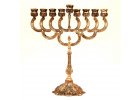
Jewish candelabrum


Product sorting
List of products

Elegant Shabbat tealight holder designed for a tealight candle Made of glass and decorated with the Star of David

size (wxdxh): 60x20x75 mm surface finish: silver packaging: box with foam lining

size (wxdxh): 60x20x75 mm surface finish: silver packaging: box with foam lining
Listing controls
A Jewish candelabrum refers both to a menorah and a hanukiah. They are a seven-branched candelabrum of the Temple in Jerusalem and a nine-branched candelabrum of the Hannukah festival, respectively. Each of them has its specific use, but their history is intertwined.
Menorah (מנורה) was a seven-branched candelabrum of the Temple in Jerusalem. Its appearence is mentioned in the Torah, specifically in the Shemot (Exodus), which describes its construction. According to Jewish symbolism, the menorah is portrayed as the burning bush that Moses saw on Mount Horeb. The seven branches of menorah is believed to be a reference to the seven days of creation. The original golden menorah was used in the Tabernacle and later in the Solomon's Temple in Jerusalem. It was lost after the destruction of the Solomon's Temple and following the construction of the Second Temple was made the new one. The new menorah was however stolen by Romans after they destroyed the Second Temple in 70 CE. Menorah is a traditional symbol of Judaism and since 1948 it has been a part of Israel's coat of arm.
Hanukiah (חנוכייה), also known as the Hannukah menorah, is a special nine-branched candelabrum used during the festival of Hannukah. Its history is a reference to the Temple's menorah miracle. After the successful Maccabean Revolt against the Seleucid Empire there was an urgent need to re-consencrate the Temple in Jerusalem by burning of the Temple's menorah. For this purpose was needed pure olive oil, but Maccabeans found only enough oil to burn for one day, but miraculously it burned for eight days, until they managed fo prepare new one. This miracle is celebrated by lighting candles on Hannukah candelabrum known as Hanukiah.
There are different types of Hanukiyot, though they have one thing in common. They are made of eight branch candle holders and one extra branch for an auxiliary candle called the shamash (literally 'attendant'), which is used to kindle the other candles. Lighting candles of Hanukiah is one of the main traditions of Hannukah. There is a prescribed way how to light up these candles. On the first night of Hanukkah light up one candle and continue in the same way the other nights in order to have eight candles on the eighth night. The custom is to light up the candles from right to left.
Shabbos candlesticks are used when lighting candles shortly before the start of Shabbos. Shabbos (also Shabbat) is a day of rest, originating from the Ten Commandments, specifically from the commandment: "Remember the day of rest, that it should be holy to you. Six days you shall work and do all your work. But the seventh day is the day of rest of the Lord your God. You shall do no work, neither you, nor your son, nor your daughter, nor your manservant, nor your maidservant, nor your livestock, nor your guest who lives within your gates. In six days the Lord made heaven and earth, the sea and everything in them, and rested on the seventh day. Therefore the Lord blessed the day of rest and set it apart as holy.” (Exodus 20:8-11). It is the central and most distinctive custom of Judaism.
We light Shabbos candles 18 minutes before the beginning of Shabbat (40 minutes before it begins in Jerusalem). There are always at least two, which refers to the two texts of the commandment about Shabbat in the Ten Commandments. While in Exodus it is written "Remember the day of rest" (זָכוֹר אֶת-יוֹם הַשַּׁבָּת), in Deuteronomy it is written "Heed the day of rest" (שָׁמוֹר אֶת-יוֹם הַשַּׁבָּת). The custom is to first light the candles, then cover your eyes, and then say the blessing. We greet Shabbat with a blessing, and if we recited it before lighting the candles, we would no longer be able to light them. Making a fire is forbidden on Shabbat.
Shabbat candlesticks have historically been made from a wide range of materials, from gold and silver, through brass and tin, to glass or crystal, and they can be very decorative or plain and simple in appearance.